| Vendor | |
|---|---|

|
Liepman Literary Agency
Marc Koralnik |
| Original language | |
| English | |
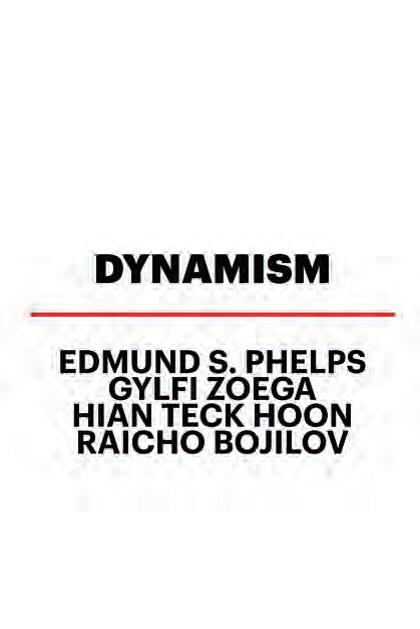
DYNAMISM
Raicho Bojilov Hian Teck Hoon Gylfi Zoega Edmund S. Phelps
The Values That Drive Innovation, Job Satisfaction, and Economic Growth
Nobel Laureate Edmund Phelps and an international group of economists argue that economic health depends on the widespread presence of certain values, in particular individualism and self-expression.
Nobel Laureate Edmund Phelps has long argued that the high level of innovation in the lead nations of the West was never a result of scientific discoveries plus entrepreneurship, as Schumpeter thought. Rather, modern valuesparticularly the individualism, vitalism, and self-expression prevailing among the peoplefueled the dynamism needed for widespread, indigenous innovation. Yet finding links between nations' values and their dynamism was a daunting task. Now, in Dynamism, Phelps and a trio of coauthors take it on.
Phelps, Gylfi Zoega, Hian Teck Hoon, and Raicho Bojilov find evidence that differences in nations' values matterand quite a lot. It is no accident that the most innovative countries in the West were rich in values fueling dynamism. Nor is it an accident that economic dynamism in the United States, Britain, and France has suffered as state-centered and communitarian values have moved to the fore.
The authors lay out their argument in three parts. In the first two, they extract from productivity data time series on indigenous innovation, then test the thesis on the link between values and innovation to find which values are positively and which are negatively linked. In the third part, they consider the effects of robots on innovation and wages, arguing that, even though many workers may be replaced rather than helped by robots, the long-term effects may be better than we have feared. Itself a significant display of creativity and innovation, Dynamism will stand as a key statement of the cultural preconditions for a healthy society and rewarding work.
EDMUND S. PHELPS won the Nobel Prize for Economics for work on the relationship between short-run and long-run effects of economic policy. He is Director of the Center for Capitalism and Society at Columbia University.
GYLFI ZOEGA is Professor of Economics at Birkbeck College, London, and a member of the Monetary Policy Committee of the Central bank of Iceland.
HIAN TECK HOON is Professor of Economics and Associate Dean (Faculty Matters and Research) at Singapore Management University.
RAICHO BOJILOV is Assistant Professor at the Faculty of Economics and Business, Pontificia Universidad Católica de Chile.
Phelps, Gylfi Zoega, Hian Teck Hoon, and Raicho Bojilov find evidence that differences in nations' values matterand quite a lot. It is no accident that the most innovative countries in the West were rich in values fueling dynamism. Nor is it an accident that economic dynamism in the United States, Britain, and France has suffered as state-centered and communitarian values have moved to the fore.
The authors lay out their argument in three parts. In the first two, they extract from productivity data time series on indigenous innovation, then test the thesis on the link between values and innovation to find which values are positively and which are negatively linked. In the third part, they consider the effects of robots on innovation and wages, arguing that, even though many workers may be replaced rather than helped by robots, the long-term effects may be better than we have feared. Itself a significant display of creativity and innovation, Dynamism will stand as a key statement of the cultural preconditions for a healthy society and rewarding work.
EDMUND S. PHELPS won the Nobel Prize for Economics for work on the relationship between short-run and long-run effects of economic policy. He is Director of the Center for Capitalism and Society at Columbia University.
GYLFI ZOEGA is Professor of Economics at Birkbeck College, London, and a member of the Monetary Policy Committee of the Central bank of Iceland.
HIAN TECK HOON is Professor of Economics and Associate Dean (Faculty Matters and Research) at Singapore Management University.
RAICHO BOJILOV is Assistant Professor at the Faculty of Economics and Business, Pontificia Universidad Católica de Chile.
| Available products |
|---|
|
Book
Published 2020-05-01 by Harvard University Press |