| Vendor | |
|---|---|

|
Liepman Literary Agency
Marc Koralnik |
| Original language | |
| English | |
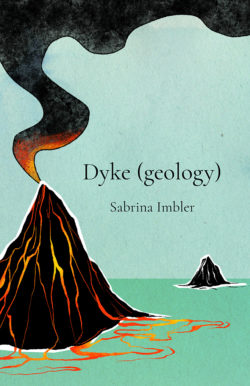
DYKE (GEOLOGY)
Through intertwined threads of autofiction, lyric science writing, and the tale of a newly queer Hawaiian volcano, Sabrina Imbler delivers a coming out story on a geological time scale. This is a small book that tackles large, wholly human questionswhat it means to live and date under white supremacy, to never know if one is loved or fetishized, how to navigate fierce desires and tectonic heartbreak through the rise and eventual eruption of a first queer love.
When two galaxies stray too near each other, the attraction between them can be so strong that the galaxies latch on and never let go. Sometimes the pull triggers head-on wrecks between starsgalactic collisionsthrowing bodies out of orbit, seamlessly into space. Sometimes the attraction only creates a giant black hole, making something whole into a kind of missing. In vivid, tensile prose, Dyke (geology) subverts the flat, neutral language of scientific journals to explore what it means to understand the Earth as something queer, volatile, and disruptive.
Extract
The history of magnetism on Earth is locked in molten rock, teased out in fiery plumes that burst forth from the mantle. As the fire dies into the hardness of basalt, it preserves the exact magnetic forces working on Earth at the time of its cooling. This is how Kohala learned of the changing of the poles. She felt it in her lava. Each explosion, therefore, is a kind of record of ecstasy: of what felt good, what hurt, what would soon disappear under clouds of ash.
Sabrina Imbler is a half-Chinese writer and dyke based in Brooklyn. She is a staff writer for Atlas Obscura and the recipient of fellowships from Jack Jones Literary Arts, the Asian American Writer's Workshop, and Paragraph NY. Sabrina wrote the monthly My Life in Sea Creatures column at Catapult and is working on a book of essays on the subject.
Extract
The history of magnetism on Earth is locked in molten rock, teased out in fiery plumes that burst forth from the mantle. As the fire dies into the hardness of basalt, it preserves the exact magnetic forces working on Earth at the time of its cooling. This is how Kohala learned of the changing of the poles. She felt it in her lava. Each explosion, therefore, is a kind of record of ecstasy: of what felt good, what hurt, what would soon disappear under clouds of ash.
Sabrina Imbler is a half-Chinese writer and dyke based in Brooklyn. She is a staff writer for Atlas Obscura and the recipient of fellowships from Jack Jones Literary Arts, the Asian American Writer's Workshop, and Paragraph NY. Sabrina wrote the monthly My Life in Sea Creatures column at Catapult and is working on a book of essays on the subject.
| Available products |
|---|
|
Book
Published 2020-03-01 by Black Lawrence Press |