| Vendor | |
|---|---|

|
Liepman Literary Agency
Marc Koralnik |
| Original language | |
| English | |
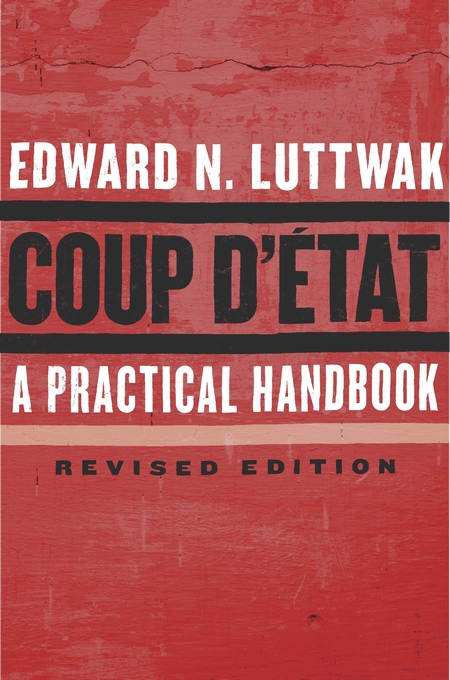
COUP D'ÉTAT
Coup d'État astonished readers when it first appeared in 1968 because it showed, step by step, how governments could be overthrown. Translated into sixteen languages, it has inspired anti-coup precautions by regimes around the world.
But the world has changed drastically since 1968indeed, even the most stable democracies today are not invulnerable to coups, given the right circumstances.
In this revised and updated edition, Edward Luttwak identifies the conditions that make countries vulnerable to a coup and outlines the necessary stages of planning, from recruitment to postcoup promises of progress and stability. But much more broadly, his investigationupdated for the twenty-first centuryuncovers important truths about the nature of political power.
The world has changed dramatically in the past half century, but not the essence of the coup d'état. It still requires the secret recruitment of military officers who command the loyalty of units well placed to seize important headquarters and key hubs in the capital city. The support of the armed forces as a whole is needed only in the aftermath, to avoid countercoups. And mass support is largely irrelevant, although passive acceptance is essential. To ensure it, violence must be kept to a minimum. The ideal coup is swift and bloodless. Very violent coups rarely succeed, and if they trigger a bloody civil war they fail utterly.
The original COUP D'ETAT was an international phenomenon. The revised edition is a significant update to this classic, one that acknowledges the ways in which our global economy can be utilized as a tool in overthrowing even stable democracies.
Luttwak identifies conditions that make countries vulnerable to a coup, and he outlines the necessary stages of planning, from recruitment of coconspirators to postcoup promises of progress and stability. But much more broadly, his investigation of coupsupdated for the twenty-first centuryuncovers important truths about the nature of political power.
In this revised and updated edition, Edward Luttwak identifies the conditions that make countries vulnerable to a coup and outlines the necessary stages of planning, from recruitment to postcoup promises of progress and stability. But much more broadly, his investigationupdated for the twenty-first centuryuncovers important truths about the nature of political power.
The world has changed dramatically in the past half century, but not the essence of the coup d'état. It still requires the secret recruitment of military officers who command the loyalty of units well placed to seize important headquarters and key hubs in the capital city. The support of the armed forces as a whole is needed only in the aftermath, to avoid countercoups. And mass support is largely irrelevant, although passive acceptance is essential. To ensure it, violence must be kept to a minimum. The ideal coup is swift and bloodless. Very violent coups rarely succeed, and if they trigger a bloody civil war they fail utterly.
The original COUP D'ETAT was an international phenomenon. The revised edition is a significant update to this classic, one that acknowledges the ways in which our global economy can be utilized as a tool in overthrowing even stable democracies.
Luttwak identifies conditions that make countries vulnerable to a coup, and he outlines the necessary stages of planning, from recruitment of coconspirators to postcoup promises of progress and stability. But much more broadly, his investigation of coupsupdated for the twenty-first centuryuncovers important truths about the nature of political power.
| Available products |
|---|
|
Book
Published 2016-04-01 by Harvard University Press |