| Vendor | |
|---|---|

|
Liepman Literary Agency
Marc Koralnik |
| Original language | |
| English | |
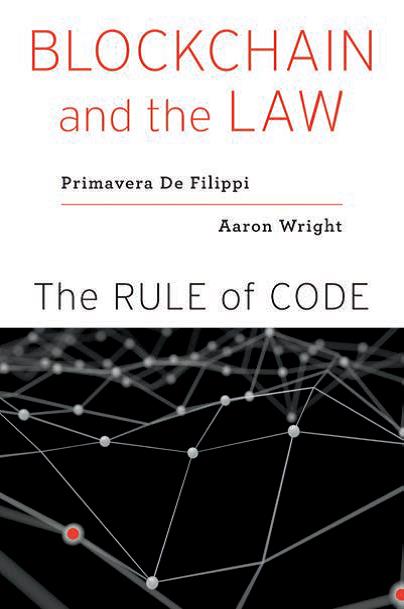
BLOCKCHAIN AND THE LAW
Primavera De Filippi Aaron Wright
The Rule of Code
An exploration of the promiseand perilsof an emerging, decentralized technology.
Since Bitcoin appeared in 2009, the digital currency has been hailed as an Internet marvel and decried as the preferred transaction vehicle for all manner of criminals. It has left nearly everyone without a computer science degree confused: Just how do you mine money from ones and zeros?
The answer lies in a technology called blockchain, which can be used for much more than Bitcoin. A general-purpose tool for creating secure, decentralized, peer-to-peer applications, blockchain technology has been compared to the Internet in both form and impact. Blockchains are used to create autonomous computer programs known as smart contracts, to expedite payments, to create financial instruments, to organize the exchange of information, and to facilitate interactions between humans and machines. The technology could also support new organizational structures that promote more democratic decision making.
Primavera De Filippi and Aaron Wright welcome these new possibilities and urge the law to catch up. Disintermediationa blockchain's greatest benefit and threatcuts out middlemen, possibly undermining the capacity of governmental authorities to supervise activities in banking, commerce, law, and other vital areas. As Blockchain and the Law makes clear, the technology cannot be harnessed productively without new rules and approaches to legal thinking.
Primavera De Filippi is a permanent researcher at the CERSA/CNRS/Université Paris II and a faculty associate at the Berkman-Klein Center for Internet & Society at Harvard Law School. Aaron Wright is Associate Clinical Professor of Law and Director of the Blockchain Project at Benjamin N. Cardozo School of Law at Yeshiva University.
The answer lies in a technology called blockchain, which can be used for much more than Bitcoin. A general-purpose tool for creating secure, decentralized, peer-to-peer applications, blockchain technology has been compared to the Internet in both form and impact. Blockchains are used to create autonomous computer programs known as smart contracts, to expedite payments, to create financial instruments, to organize the exchange of information, and to facilitate interactions between humans and machines. The technology could also support new organizational structures that promote more democratic decision making.
Primavera De Filippi and Aaron Wright welcome these new possibilities and urge the law to catch up. Disintermediationa blockchain's greatest benefit and threatcuts out middlemen, possibly undermining the capacity of governmental authorities to supervise activities in banking, commerce, law, and other vital areas. As Blockchain and the Law makes clear, the technology cannot be harnessed productively without new rules and approaches to legal thinking.
Primavera De Filippi is a permanent researcher at the CERSA/CNRS/Université Paris II and a faculty associate at the Berkman-Klein Center for Internet & Society at Harvard Law School. Aaron Wright is Associate Clinical Professor of Law and Director of the Blockchain Project at Benjamin N. Cardozo School of Law at Yeshiva University.
| Available products |
|---|
|
Book
Published 2018-04-01 by Harvard University Press |