| Vendor | |
|---|---|

|
Fritz Agency
Christian Dittus |
| Original language | |
| English | |
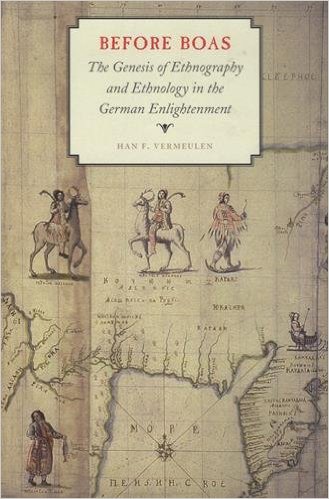
BEFORE BOAS
The Genesis of Ethnography and Ethnology in the German Enlightenment
The history of anthropology has been written from multiple viewpoints, often from perspectives of gender, nationality, theory, or politics. Before Boas delves deeper into issues concerning anthropology's academic origins to present a groundbreaking study that reveals how ethnology and ethnography originated during the eighteenth rather than the nineteenth century, developing parallel to anthropology, or the natural history of man.
Han F. Vermeulen explores primary and secondary sources from Russia, Germany, Austria, the United States, the Netherlands, Hungary, the Czech Republic, Slovakia, France, and Great Britain in tracing how ethnography was begun as field research by German-speaking historians and naturalists in Siberia (Russia) during the 1730s and 1740s, was generalized as ethnology by scholars in Goettingen (Germany) and Vienna (Austria) during the 1770s and 1780s, and was subsequently adopted by researchers in other countries.
Before Boas argues that anthropology and ethnology were separate sciences during the Age of Reason, studying racial and ethnic diversity, respectively. Ethnography and ethnology focused not on other cultures but on all peoples of all eras. Following G. W. Leibniz, researchers in these fields categorized peoples primarily according to their languages. Franz Boas professionalized the holistic study of anthropology from the 1880s into the twentieth century.
Han F. Vermeulen is a research associate at the Max Planck Institute for Social Anthropology in Halle (Saale) and the Max Planck Institute for the History of Science in Berlin.
Han F. Vermeulen explores primary and secondary sources from Russia, Germany, Austria, the United States, the Netherlands, Hungary, the Czech Republic, Slovakia, France, and Great Britain in tracing how ethnography was begun as field research by German-speaking historians and naturalists in Siberia (Russia) during the 1730s and 1740s, was generalized as ethnology by scholars in Goettingen (Germany) and Vienna (Austria) during the 1770s and 1780s, and was subsequently adopted by researchers in other countries.
Before Boas argues that anthropology and ethnology were separate sciences during the Age of Reason, studying racial and ethnic diversity, respectively. Ethnography and ethnology focused not on other cultures but on all peoples of all eras. Following G. W. Leibniz, researchers in these fields categorized peoples primarily according to their languages. Franz Boas professionalized the holistic study of anthropology from the 1880s into the twentieth century.
Han F. Vermeulen is a research associate at the Max Planck Institute for Social Anthropology in Halle (Saale) and the Max Planck Institute for the History of Science in Berlin.
| Available products |
|---|
|
Book
Published 2015-07-01 by University of Nebraska Press |