| Vendor | |
|---|---|

|
Mohrbooks Literary Agency
Sebastian Ritscher |
| Original language | |
| English | |
| Categories | |
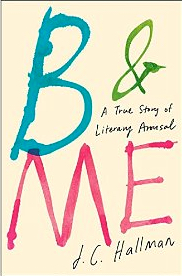
B & ME
A True Story of Literary Arousal
This is a book about books, the record of one reader's literary quest through the great canons, following in the wake of the author's obsession with Nicholson Baker and postmodern thought.
It's not often that the same person is compared to Tom Wolfe, Hunter Thompson, Bruce Chatwin, Alain de Botton, John McPhee, George Saunders, Sam Lipsyte, Cheever, Hawthorne, Donald Barthelme, Shirley Jackson, Rod Serling, Woody Allen, Kafka and Gogol. It takes a special flair to aggregate a list like that. But those are the comparisons that people list when they write about J.C. Hallman's work. B & Me is is more than a literary journey: it is an argument against cynicism, against inertia, and a call-to-arms for devotees of reading everywhere. It will appeal to armchair philosophers and thinking readers alike, particularly in markets already familiar with Nicholson Baker's innovations. In particular, it's about Nicholson Baker in the same way that U & I by Nicholson Baker is about John Updike: it not about Baker per se, but Baker is the vehicle driving the larger questions toward a greater truth.
In his own right, Hallman tackles the age-old questions that surround mankind?s greatest pastime: what does it mean to become a reader; how does it happen and why does it matter so much? Drawing on his own experience, Hallman offers a response that is accessible, generous, and driven.
Consummately intelligent, passionately bookish, Hallman?s energy is contagious. Like the author, the reader may find his world overtaken by a reawakened hunger for the written word. J.C. Hallman studied creative writing as an undergraduate at the University of Pittsburgh. He was accepted to the Iowa Writers? Workshop at twenty-one, at the time one of the youngest writers ever admitted to the program. He graduated in 1991 and began publishing short fiction not long after. He later graduated from the Johns Hopkins Writing Seminars. He's published a variety of fiction and nonfiction in venues ranging from The Believer and Tin House, to Bookforum and GQ, to Salon and Bookslut. He received a Michener Fellowship and a McKnight Artist Grant. Recently, he won a Pushcart Prize and was included in the Best American Travel Writing 2010 (ed. Bill Buford), and received an award from Creative Nonfiction Magazine for a recent essay contest judged by Susan Orlean.
All of his books combine copious research with funny, illustrative personal narrative. His first nonfiction book, The Chess Artist (St. Martin?s, 2003), describes his sometimes-antagonistic relationship with an African-American chess master. (?Irreverent, insightful and funny,? The Chicago Tribune; ?Transcends its subject a writer who displays artistry writing about chess,? The Financial Times.) His second book, The Devil is a Gentleman (Random House, 2006), is about William James and a variety of new religious movements. (?The best summary of the Trinity I have ever encountered,? The New York Times Book Review; ?A deeply complex and thoughtful work,? The Saint Petersburg Times; ?A Jamesian reading of current American religious experience,? The Financial Times.) His third book, In Utopia (St. Martin?s, 2010), explores the history of optimistic literature. (?Scholarly, humorous, at times provocative, and always entertaining,? The Iowa City Press-Citizen; ?An ironic, Alain de Botton-style of erudite bonhomie and self-referential postmodernism,? Publisher?s Weekly.) Finally, his collection of stories, The Hospital for Bad Poets (Milkweed, 2009), reveals an inventive, experimental bent. (?Reconfigures our everyday errors and flaws into deeply affecting fiction,? The New York Times Book Review; ?Like Kafka before him, he?s on the make for sturdy truths,? The Los Angeles Times; ?Sam Lipsyte crossed with early George Saunders,? Publisher?s Weekly.
In his own right, Hallman tackles the age-old questions that surround mankind?s greatest pastime: what does it mean to become a reader; how does it happen and why does it matter so much? Drawing on his own experience, Hallman offers a response that is accessible, generous, and driven.
Consummately intelligent, passionately bookish, Hallman?s energy is contagious. Like the author, the reader may find his world overtaken by a reawakened hunger for the written word. J.C. Hallman studied creative writing as an undergraduate at the University of Pittsburgh. He was accepted to the Iowa Writers? Workshop at twenty-one, at the time one of the youngest writers ever admitted to the program. He graduated in 1991 and began publishing short fiction not long after. He later graduated from the Johns Hopkins Writing Seminars. He's published a variety of fiction and nonfiction in venues ranging from The Believer and Tin House, to Bookforum and GQ, to Salon and Bookslut. He received a Michener Fellowship and a McKnight Artist Grant. Recently, he won a Pushcart Prize and was included in the Best American Travel Writing 2010 (ed. Bill Buford), and received an award from Creative Nonfiction Magazine for a recent essay contest judged by Susan Orlean.
All of his books combine copious research with funny, illustrative personal narrative. His first nonfiction book, The Chess Artist (St. Martin?s, 2003), describes his sometimes-antagonistic relationship with an African-American chess master. (?Irreverent, insightful and funny,? The Chicago Tribune; ?Transcends its subject a writer who displays artistry writing about chess,? The Financial Times.) His second book, The Devil is a Gentleman (Random House, 2006), is about William James and a variety of new religious movements. (?The best summary of the Trinity I have ever encountered,? The New York Times Book Review; ?A deeply complex and thoughtful work,? The Saint Petersburg Times; ?A Jamesian reading of current American religious experience,? The Financial Times.) His third book, In Utopia (St. Martin?s, 2010), explores the history of optimistic literature. (?Scholarly, humorous, at times provocative, and always entertaining,? The Iowa City Press-Citizen; ?An ironic, Alain de Botton-style of erudite bonhomie and self-referential postmodernism,? Publisher?s Weekly.) Finally, his collection of stories, The Hospital for Bad Poets (Milkweed, 2009), reveals an inventive, experimental bent. (?Reconfigures our everyday errors and flaws into deeply affecting fiction,? The New York Times Book Review; ?Like Kafka before him, he?s on the make for sturdy truths,? The Los Angeles Times; ?Sam Lipsyte crossed with early George Saunders,? Publisher?s Weekly.
| Available products |
|---|
|
Book
Published 2015-02-01 by Simon & Schuster |
|
Book
Published 2015-02-01 by Simon & Schuster |