| Vendor | |
|---|---|

|
Mohrbooks Literary Agency
Sebastian Ritscher |
| Original language | |
| English | |
| Categories | |
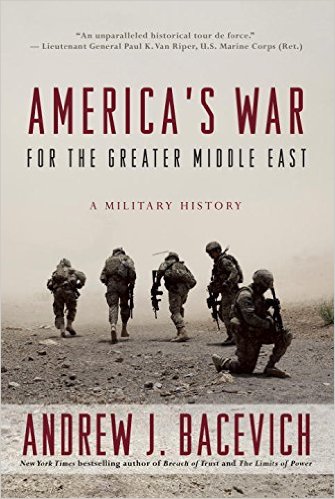
AMERICA'S WAR FOR THE GREATER MIDDLE EAST
A Military History
Retired army colonel and New York Times bestselling author Andrew J. Bacevich provides a searing reassessment of U.S. military policy in the Middle East over the past four decades.
From the end of World War II until 1980, virtually no American soldiers were killed in action while serving in the Greater Middle East. Since 1990, virtually no American soldiers have been killed in action anywhere else. What caused this shift? Andrew J. Bacevich, one of the country’s most respected voices on foreign affairs, offers an incisive critical history of this ongoing military enterprise—now more than thirty years old and with no end in sight.
During the 1980s, Bacevich argues, a great transition occurred. As the Cold War wound down, the United States initiated a new conflict—a War for the Greater Middle East—that continues to the present day. The long twilight struggle with the Soviet Union had involved only occasional and sporadic fighting. But as this new war unfolded, hostilities became persistent. From the Balkans and East Africa to the Persian Gulf and Central Asia, U.S. forces embarked upon a seemingly endless series of campaigns across the Islamic world. Few achieved anything remotely like conclusive success. Instead, actions undertaken with expectations of promoting peace and stability produced just the opposite. As a consequence, phrases like “permanent war” and “open-ended war” have become part of everyday discourse.
Connecting the dots in a way no other historian has done before, Bacevich weaves a compelling narrative out of episodes as varied as the Beirut bombing of 1983, the Mogadishu firefight of 1993, the invasion of Iraq in 2003, and the rise of ISIS in the present decade. Understanding what America’s costly military exertions have wrought requires seeing these seemingly discrete events as parts of a single war. It also requires identifying the errors of judgment made by political leaders in both parties and by senior military officers who share responsibility for what has become a monumental march to folly. This Bacevich unflinchingly does.
A twenty-year army veteran who served in Vietnam, Andrew J. Bacevich brings the full weight of his expertise to this vitally important subject. America’s War for the Greater Middle East is a bracing after-action report from the front lines of history. It will fundamentally change the way we view America’s engagement in the world’s most volatile region.
Andrew J. Bacevich is a retired professor of history and international relations at Boston University. A graduate of the U.S. Military Academy, he served for twenty-three years as a commissioned officer in the United States Army. He received his PhD in American diplomatic history from Princeton. Before joining the faculty of Boston University in 1998, he taught at West Point and at Johns Hopkins University. His three most recent books—Breach of Trust, Washington Rules, and The Limits of Power—all hit the New York Times bestseller list. A winner of the Lannan Notable Book Award, he lectures frequently at universities around the country. He lives with his wife, Nancy, in Walpole, Massachusetts.
During the 1980s, Bacevich argues, a great transition occurred. As the Cold War wound down, the United States initiated a new conflict—a War for the Greater Middle East—that continues to the present day. The long twilight struggle with the Soviet Union had involved only occasional and sporadic fighting. But as this new war unfolded, hostilities became persistent. From the Balkans and East Africa to the Persian Gulf and Central Asia, U.S. forces embarked upon a seemingly endless series of campaigns across the Islamic world. Few achieved anything remotely like conclusive success. Instead, actions undertaken with expectations of promoting peace and stability produced just the opposite. As a consequence, phrases like “permanent war” and “open-ended war” have become part of everyday discourse.
Connecting the dots in a way no other historian has done before, Bacevich weaves a compelling narrative out of episodes as varied as the Beirut bombing of 1983, the Mogadishu firefight of 1993, the invasion of Iraq in 2003, and the rise of ISIS in the present decade. Understanding what America’s costly military exertions have wrought requires seeing these seemingly discrete events as parts of a single war. It also requires identifying the errors of judgment made by political leaders in both parties and by senior military officers who share responsibility for what has become a monumental march to folly. This Bacevich unflinchingly does.
A twenty-year army veteran who served in Vietnam, Andrew J. Bacevich brings the full weight of his expertise to this vitally important subject. America’s War for the Greater Middle East is a bracing after-action report from the front lines of history. It will fundamentally change the way we view America’s engagement in the world’s most volatile region.
Andrew J. Bacevich is a retired professor of history and international relations at Boston University. A graduate of the U.S. Military Academy, he served for twenty-three years as a commissioned officer in the United States Army. He received his PhD in American diplomatic history from Princeton. Before joining the faculty of Boston University in 1998, he taught at West Point and at Johns Hopkins University. His three most recent books—Breach of Trust, Washington Rules, and The Limits of Power—all hit the New York Times bestseller list. A winner of the Lannan Notable Book Award, he lectures frequently at universities around the country. He lives with his wife, Nancy, in Walpole, Massachusetts.
| Available products |
|---|
|
Book
Published 2016-04-05 by Random House |
|
Book
Published 2016-04-05 by Random House |