| Vendor | |
|---|---|

|
Liepman Literary Agency
Marc Koralnik |
| Original language | |
| English | |
| Weblink | |
| http://www.hup.harvard.edu/catal … | |
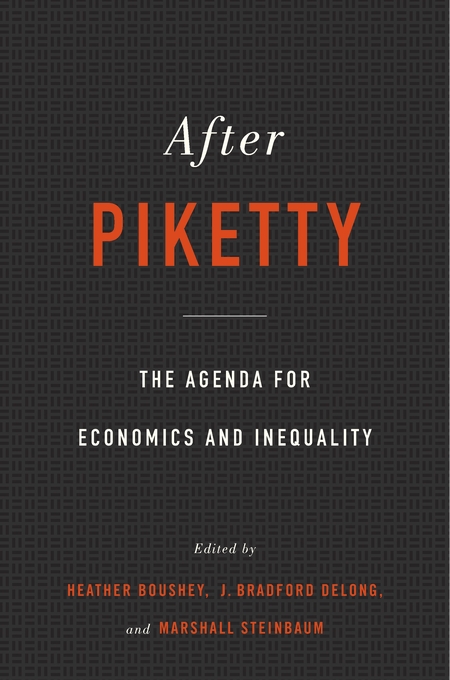
AFTER PIKETTY
Marshall Steinbaum Heather Boushey Bradford J. DeLong
The Agenda for Economics and Inequality
An indispensable interdisciplinary work, After Piketty does not shy away from the seemingly intractable problems that made Capital in the Twenty-First Century so compelling for so many.
Thomas Piketty's Capital in the Twenty-First Century is the most widely discussed work of economics in recent history, selling millions of copies in dozens of languages. But are its analyses of inequality and economic growth on target? Where should researchers go from here in exploring the ideas Piketty pushed to the forefront of global conversation? A cast of economists and other social scientists tackle these questions in dialogue with Piketty, in what is sure to be a much-debated book in its own right.
After Piketty opens with a discussion by Arthur Goldhammer, the book's translator, of the reasons for Capital's phenomenal success, followed by the published reviews of Nobel laureates Paul Krugman and Robert Solow. The rest of the book is devoted to newly commissioned essays that interrogate Piketty's arguments. Suresh Naidu and other contributors ask whether Piketty said enough about power, slavery, and the complex nature of capital. Laura Tyson and Michael Spence consider the impact of technology on inequality. Heather Boushey, Branko Milanovic, and others consider topics ranging from gender to trends in the global South. Emmanuel Saez lays out an agenda for future research on inequality, while a variety of essayists examine the book's implications for the social sciences more broadly. Piketty replies to these questions in a substantial concluding chapter.
The book itself is a collection of essays discussing the pros and cons of Piketty's book, featuring two published reviews by Nobel Laureates Paul Krugman and Robert Solow, and featuring new essays by luminaries such as Suresh Naidu, Laura Tyson, Michael Spence, Branko Milanovic, Emmanueal Saez, and others.
Heather Boushey is Executive Director and Chief Economist at the Washington Center for Equitable Growth.
J. Bradford DeLong is Professor of Economics at the University of California, Berkeley.
Marshall Steinbaum is Fellow at the Roosevelt Institute, New York.
After Piketty opens with a discussion by Arthur Goldhammer, the book's translator, of the reasons for Capital's phenomenal success, followed by the published reviews of Nobel laureates Paul Krugman and Robert Solow. The rest of the book is devoted to newly commissioned essays that interrogate Piketty's arguments. Suresh Naidu and other contributors ask whether Piketty said enough about power, slavery, and the complex nature of capital. Laura Tyson and Michael Spence consider the impact of technology on inequality. Heather Boushey, Branko Milanovic, and others consider topics ranging from gender to trends in the global South. Emmanuel Saez lays out an agenda for future research on inequality, while a variety of essayists examine the book's implications for the social sciences more broadly. Piketty replies to these questions in a substantial concluding chapter.
The book itself is a collection of essays discussing the pros and cons of Piketty's book, featuring two published reviews by Nobel Laureates Paul Krugman and Robert Solow, and featuring new essays by luminaries such as Suresh Naidu, Laura Tyson, Michael Spence, Branko Milanovic, Emmanueal Saez, and others.
Heather Boushey is Executive Director and Chief Economist at the Washington Center for Equitable Growth.
J. Bradford DeLong is Professor of Economics at the University of California, Berkeley.
Marshall Steinbaum is Fellow at the Roosevelt Institute, New York.
| Available products |
|---|
|
Book
Published 2017-05-01 by Harvard University Press |