| Vendor | |
|---|---|

|
Fritz Agency
Christian Dittus |
| Original language | |
| English | |
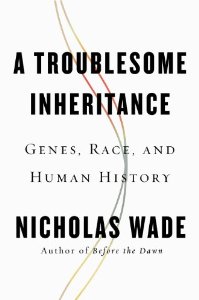
A TROUBLESOME INHERITANCE
Genes, Race and Human History
Drawing on startling new evidence from the mapping of the genome, an explosive new account of the genetic basis of race and its role in the human story
Fewer ideas have been more toxic or harmful, or have been used for worse ends, than the idea of the biological reality of race, and with it the idea that humans of different races are biologically different from each other. Nicholas Wade, though inconvenient as it may be, feels that there is truth in this view. Race is inherently not a bright-line distinction; by definition it means that the more human populations are kept apart from each other and for longer periods of time, the more they will evolve their own distinct, separate traits under the selective pressure known as Darwinian evolution.
The most controversial claims made by Wade in his book involve the genetic basis of human social habits, such as the genetic basis for the tendency to be more or less violent. Inevitably such assertions get caught up in questions of better and worse, which are pernicious; what Wade is arguing is the much more subtle point that some traits are more adaptive for some specific environments than others.
In any event, issues of genetics are probabilistic, and involve a distribution of the trait along a bell curve. Wade's point is that science needs to set its course for the truth, come what may, taboos or no; science is one thing, the fundamental ethical principle of human equality, about which he is crystal clear, is something else entirely. For the brave, scrupulous care, and lucidity with which Wade nonetheless forays into this scientific minefield and endeavors to arrive at a coherent summary of what the new genetic science does and does not tell us about race and human history. This will not be the final word on the subject, but it will begin a mighty and in some respects overdue conversation.
Nicholas Wade is a a longtime reporter for The New York Times's Science section and previously was the editor of Science Magazine. He is also the author of six books, including THE FAITH INSTINCT which discusses the evolutions of religious behavior and is the follow up to BEFORE THE DAWN.
The most controversial claims made by Wade in his book involve the genetic basis of human social habits, such as the genetic basis for the tendency to be more or less violent. Inevitably such assertions get caught up in questions of better and worse, which are pernicious; what Wade is arguing is the much more subtle point that some traits are more adaptive for some specific environments than others.
In any event, issues of genetics are probabilistic, and involve a distribution of the trait along a bell curve. Wade's point is that science needs to set its course for the truth, come what may, taboos or no; science is one thing, the fundamental ethical principle of human equality, about which he is crystal clear, is something else entirely. For the brave, scrupulous care, and lucidity with which Wade nonetheless forays into this scientific minefield and endeavors to arrive at a coherent summary of what the new genetic science does and does not tell us about race and human history. This will not be the final word on the subject, but it will begin a mighty and in some respects overdue conversation.
Nicholas Wade is a a longtime reporter for The New York Times's Science section and previously was the editor of Science Magazine. He is also the author of six books, including THE FAITH INSTINCT which discusses the evolutions of religious behavior and is the follow up to BEFORE THE DAWN.
| Available products |
|---|
|
Book
Published 2014-05-01 by Penguin Press |