| Vendor | |
|---|---|

|
Liepman Literary Agency
Marc Koralnik |
| Original language | |
| English | |
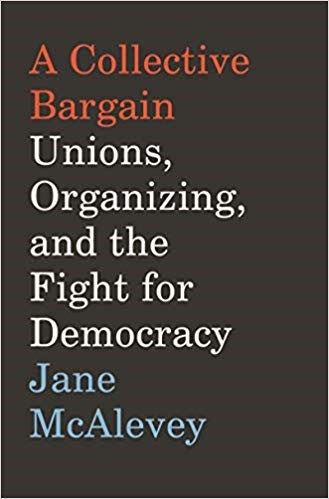
A COLLECTIVE BARGAIN
Unions, Organizing, and the Fight for Democracy
From longtime labor organizer Jane McAlevey, a vital call-to-arms in favor of unions, the only force capable of defending our democracy.
For decades, intractable social and economic problems have been eating away at the social fabric of the United States. The crisis is now so deep it's threatening democracy itself. Income inequality has reached epic proportions, resulting in a lopsided political system that bestows tax breaks on the rich while the rest of the country has been economically abandoned. There's a single, obvious solution to these problems, one with a long, successful history, but one that too many have forgotten: unions.
In A COLLECTIVE BARGAIN, longtime labor, environmental, and political organizer Jane McAlevey makes the case that unions are the only institution capable of fighting back against today's super-rich corporate class. Since the 1930s, when unions briefly flourished under New Deal protections, corporations have waged a stealthy and ruthless war against the labor movement. Today, McAlevey argues, it's time for unions to make a comeback. Want to reverse the nation's mounting wealth gap? Put an end to sexual harassment in the workplace? End racial disparities on the job? Negotiate climate justice? Bring back unions.
Alongside McAlevey, we travel from Pennsylvania hospitals, where we're thrust into a herculean fight in which nurses are building a new kind of patient-centered unionism; to Silicon Valley, where tech workers, fed up with the illusory promise of a better world, have turned to old-fashioned collective action; and inside the most promising anti-austerity rebellion in years, the one being waged by America's teachers.
A rousing and electrifying manifesto, A COLLECTIVE BARGAIN shows us why we must strengthen and defend the only force capable of fighting back against social injustice and the alarming right-wing shift in our politics: a strong, democratic union movement.
JANE MCALEVEY is an organizer, author and scholar. Her first book, Raising Expectations (and Raising Hell) (Verso Press) was named the most valuable book of 2012 by The Nation Magazine. Her second book, No Shortcuts: Organizing for Power in the New Gilded Age (Oxford) was released late in 2016. She is a regular commentator on radio and TV. She continues to work as an organizer on union campaigns, lead contract negotiations, and train and develop organizers.
In A COLLECTIVE BARGAIN, longtime labor, environmental, and political organizer Jane McAlevey makes the case that unions are the only institution capable of fighting back against today's super-rich corporate class. Since the 1930s, when unions briefly flourished under New Deal protections, corporations have waged a stealthy and ruthless war against the labor movement. Today, McAlevey argues, it's time for unions to make a comeback. Want to reverse the nation's mounting wealth gap? Put an end to sexual harassment in the workplace? End racial disparities on the job? Negotiate climate justice? Bring back unions.
Alongside McAlevey, we travel from Pennsylvania hospitals, where we're thrust into a herculean fight in which nurses are building a new kind of patient-centered unionism; to Silicon Valley, where tech workers, fed up with the illusory promise of a better world, have turned to old-fashioned collective action; and inside the most promising anti-austerity rebellion in years, the one being waged by America's teachers.
A rousing and electrifying manifesto, A COLLECTIVE BARGAIN shows us why we must strengthen and defend the only force capable of fighting back against social injustice and the alarming right-wing shift in our politics: a strong, democratic union movement.
JANE MCALEVEY is an organizer, author and scholar. Her first book, Raising Expectations (and Raising Hell) (Verso Press) was named the most valuable book of 2012 by The Nation Magazine. Her second book, No Shortcuts: Organizing for Power in the New Gilded Age (Oxford) was released late in 2016. She is a regular commentator on radio and TV. She continues to work as an organizer on union campaigns, lead contract negotiations, and train and develop organizers.
| Available products |
|---|
|
Book
Published 2020-01-01 by Ecco |