| Vendor | |
|---|---|

|
Liepman Literary Agency
Marc Koralnik |
| Original language | |
| French | |
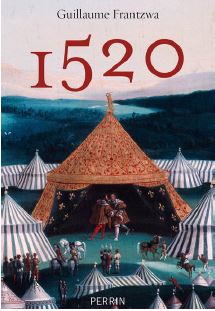
1520: The End of Christianity
Five centuries ago, the Middle Ages gave way to modernity in Europe.
Most of the period's key dates were witness to founding events. The year 476 marked the end of the Western Roman Empire, 800 the coronation of Charlemagne, 1453 the fall of Constantinople, 1492 the discovery of the New World. All of these had significant impact: the sudden end of an era or the start of a new one. The year 1520 was also one of transition, but it was not characterized by a major event, rather an accumulation of facts that toppled the Middle Ages into Modernity.
In 1520, European rivalries intensified. Two young rulers, Charles V and Francis I, envisioned a universal empire. Amid the magnificence of the Field of the Cloth of Gold, Europe became fragmented, while a pressing enemy awakened in the East with the advent of Suleiman the Magnificent. A dynamic of expansion exacerbated these tensions: following Spain's example, France and England embarked on colonization while Portugal extended its domination from Brazil to China. It was a time of great discoveries with Magellan and profound transformation of our knowledge of the world. Finally, the arts were caught up in the movement, from the last pointed spires of the Gothic age to the brilliance of the Renaissance. The latter encouraged both criticism of a society grappling with doubt and also dreams of a golden age, which inspired Luther's drive to rip apart the Christian establishment.
Guillaume Frantzwa skilfully portrays the high and low moments of this fertile period. By breaking with Christianity, it inaugurated a new world order, that of modern Europe.
GUILLAUME FRANTZWA is a paleographic archivist with a doctorate in art history from the University of Paris-I. He is heritage curator at the Centre des archives diplomatiques.
In 1520, European rivalries intensified. Two young rulers, Charles V and Francis I, envisioned a universal empire. Amid the magnificence of the Field of the Cloth of Gold, Europe became fragmented, while a pressing enemy awakened in the East with the advent of Suleiman the Magnificent. A dynamic of expansion exacerbated these tensions: following Spain's example, France and England embarked on colonization while Portugal extended its domination from Brazil to China. It was a time of great discoveries with Magellan and profound transformation of our knowledge of the world. Finally, the arts were caught up in the movement, from the last pointed spires of the Gothic age to the brilliance of the Renaissance. The latter encouraged both criticism of a society grappling with doubt and also dreams of a golden age, which inspired Luther's drive to rip apart the Christian establishment.
Guillaume Frantzwa skilfully portrays the high and low moments of this fertile period. By breaking with Christianity, it inaugurated a new world order, that of modern Europe.
GUILLAUME FRANTZWA is a paleographic archivist with a doctorate in art history from the University of Paris-I. He is heritage curator at the Centre des archives diplomatiques.
| Available products |
|---|
|
Book
Published 2020-03-01 by Perrin |